


BURNT STORE MARINA COMMUNITY IRRIGATION
Let’s flash back to February 2017, when the irrigation committee was formed to oversee the operations of the community irrigation system. All the original members are still on the committee. Besides me, there is Joe Baker, Mike Lemon and Gayle Shafer. Willie Burns joined the committee in 2025.
The committee knew it had an enormous task in front of it. In February of 2017, I inspected the pump house prior to the amenity sale, looking for items that may have been missing during the discovery process phase of the sale. That inspection uncovered several items totaling an estimated $200K to $300K. This gave the board additional leverage in the negotiations of the amenity sales. The list that was presented to the board was confirmed by Hoover Pumping.
The irrigation committee met weekly for over a year. Mr. Hoover of Hoover Pumping, who designed the irrigation system, came to speak to the committee, giving tremendous insight into the structure, operation and maintenance of the irrigation system. The committee will be forever grateful to Mr. Hoover for his insight. During the first month of getting our hands around what we had, the committee developed an action list of 29 items.
We immediately started attacking the list. Back then, the reserves fund had just been established, so there was little money available for projects other than the irrigation operating budget. Some were as simple as identifying the location of all the water meters. The person who read the meters was the only person that knew the location of the water meters. The meters are now documented by GPS location, with pictures of each meter. If you looked up at the circuit breaker boxes from the bottom, you could see the sky through them. The entire electrical panel had to be replaced. We completed this a couple of weeks before Hurricane Irma hit in September 2017.
Other projects took longer to complete. Prior to the amenities being sold to BSM, the developer wanted to build additional condos, which was thwarted by community action. No one knew that the developer modified the water permit, removing almost all water from golf course usage. The committee discovered this by reviewing the irrigation documentation given by the seller to BSM. South Florida Water Management (SFWM) was approached with the idea of keeping the total water available at 432 million gallons per year, but allowing BSM to decide where it could be used as needed between the golf course and the community irrigation system. SFWM eagerly accepted the requested change as it required one less report they had to deal with. This is the water use permit we have today and was the beginning of the recovery of the golf course.
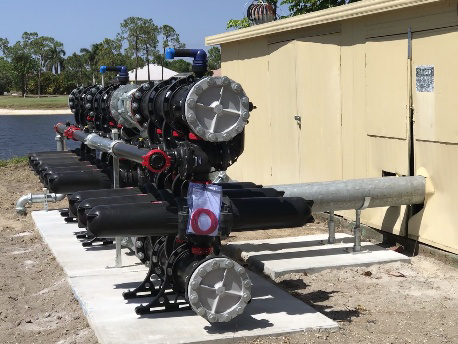
The water use permit only allows water to be withdrawn from Lower Hawthorne Aquifer. As such, we are limited in the quality of water we receive. There are things that can be done to improve the water quality as it enters our system, and even after it’s in our pipes. The original system had no filter installed before the water entered our piping from the pump house. At a cost of approximately $70K a filter was installed in April 2018 (picture right). This filter removes any particle larger than a human hair.
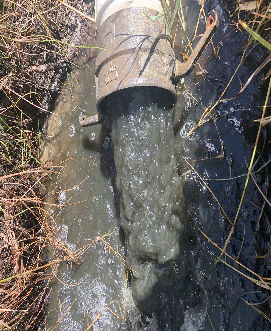
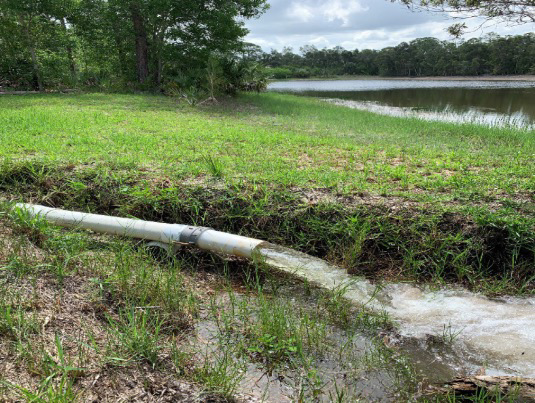
It seemed that the community irrigation system had never been flushed so there was forty years of build-up on the inside walls of the piping. We started flushing the irrigation system in the late summer of 2018 when there was an ample supply of water in the irrigation pond. Bryozoa was identified as the initial item in the water supply to attack. Our flushes over the next few years focused on Bryozoan removal. The picture on the left is of the water coming out from start of the first flush back in 2018. The picture on the right is the water coming out from the start of the flush in 2024.
As drought has become more prevalent over the last 10 years, and without the availability of reclaimed water, having enough water available in the dry winter months became a big issue for the committee to deal with. The committee purchased a 600 gpm portable pump that could be attached to our irrigation piping. Changing the settings of the valves allowed the water from the pump (Charlee Rd Pond) to go directly into the irrigation pond. This requires the irrigation system to be turned off during the day when the pumping occurs. The system is turned on at 4 p.m. and is available until 8 a.m. the following morning when it is shut off again to resume pumping. The irrigation system is available 24/7 on weekends. With this pump we break even on the water in the pond.
The dominant Bryozoan issue was hiding a major buildup of shells. Today, we flush the irrigation four times per year focusing on removing the shells from the piping. This is an ongoing issue that will take several more flushes before the problem is adequately addressed.
Where do we go from here? The availability of water during the dry winter season puts a lot of stress on the system to supply water. The board of directors in 2025 authorized the drilling of two new wells; one for the golf course, and the other for the community irrigation. The well for the golf course is complete and up and running. Instead of the usual 200 ft deep wells that currently exist, we went down to 820 ft deep putting us squarely in the middle of the aquifer. The initial water quality sample shows the salt level from the new well is 500 ppm. A far cry from our other shallower wells at 5,000 ppm. It is too soon to say where the final salt level will end up, but the data so far is promising.
The community well has yet to be dug. We are negotiating the start date with the driller. The community well should also be about 800 ft deep.
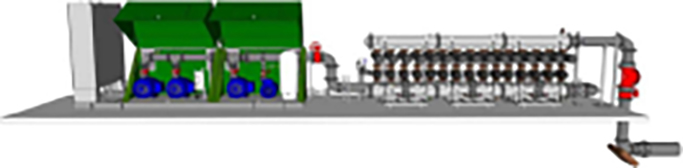
The pump house, pumps, etc., are on their last leg and need replacement soon. Bids are being obtained for the work. The ancient 100 hp pumps will be replaced with modern efficient 50 hp pumps without a loss of capacity. There is only one other community in the southeast United States that still uses the old 100 hp pumps according to Hoover. Parts take weeks to get, causing extended down time. The intake pipes will be lengthened to extend to the center of the pond giving them less chance for resting on the bottom during the dry season, digging themselves under the bottom surface. The building itself will be torn down and replaced with fan vented clam shell covers over the equipment removing the eyesore. The clam shell covers can’t be seen over the bushes surrounding the pump house area. The drawing above is the rendering from one of the bidders of what the new “pump house” would look like.
Finally, the board of directors and the community irrigation committee are looking at ways to streamline the process for meter reading and invoicing. The committee has made a recommendation of its own, plus an outside consultant was hired to study our system and make recommendations. One of the goals is to reduce the dependency on people in the process. This will require investment in new meter technology no matter what solution is adopted. The consultant is finishing the study at this time.