


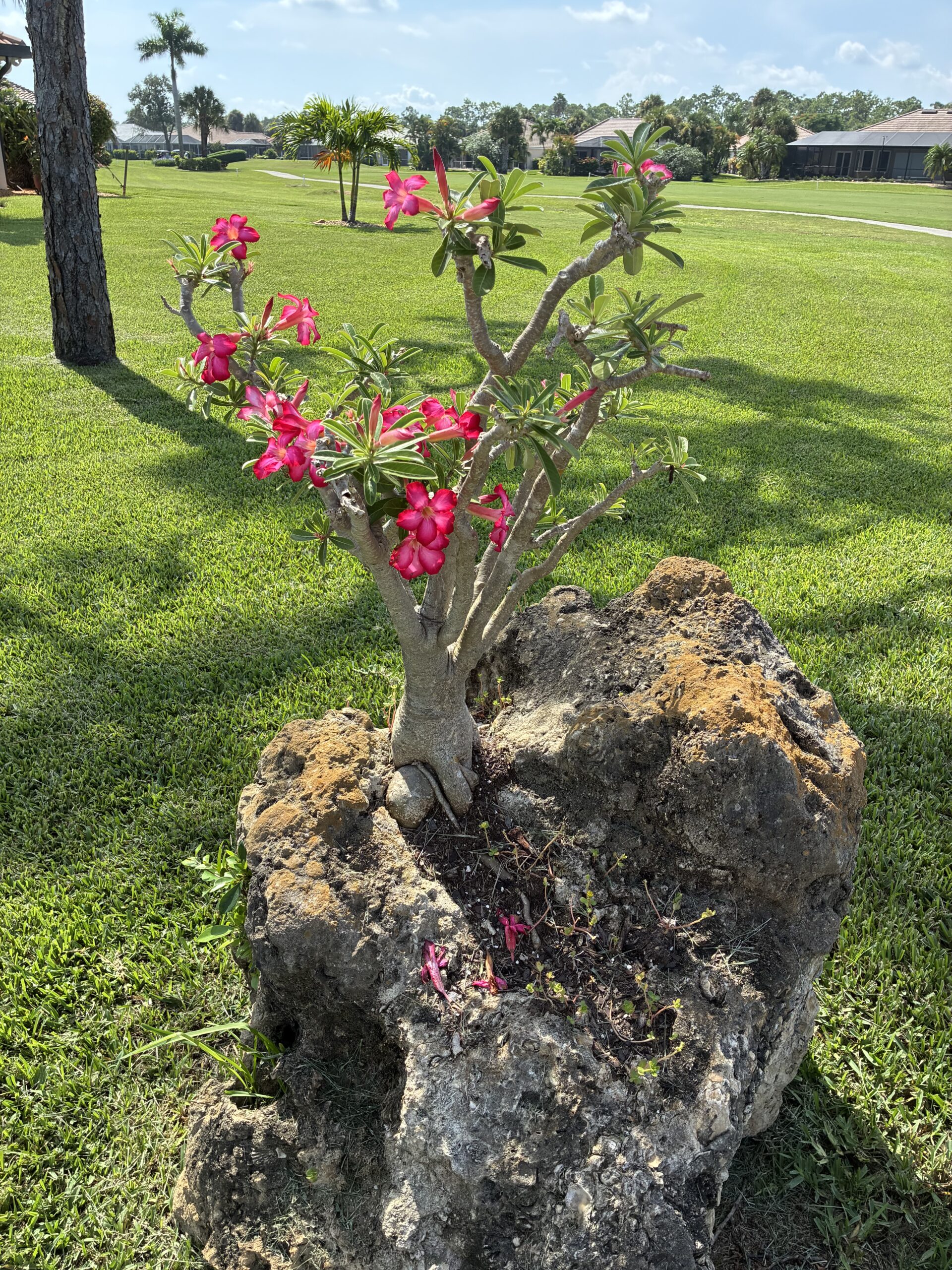
DESERT ROSE IN BACK OF TIEDEMANNS’ HOME ON PELICAN 7.
You have probably seen them around The Marina – in pots, by mailboxes and on lanais. The desert rose has become very popular in southwest Florida. But – what are they, where do they come from, and how do you care for them?
The desert rose, originates from the tropical and subtropical regions of eastern and southern Africa, including the Arabian Peninsula, and has also been introduced to Madagascar and Sri Lanka.
Desert rose is a low-maintenance succulent that produces dozens of trumpet-shaped flowers in many shades of pink, rose, or white in the summer. Like many succulents, it needs conditions that are bright, warm, and dry.
Desert rose (Adenium obesum) and its many hybrids are regularly seen in retail garden centers – there is a whole “room” of them at the new Depot Nursery on Burnt Store Road. Their flowers average 2 – 3 inches in diameter, and may have single, double, or even triple rows of petals. To maintain the profuse flowering, the plants must get six hours or more of bright light each day. Plants may naturally droop a bit during winter, but they will re-leaf after the cold season has passed.
The desert rose makes a dramatic plant for a deck or patio, but since it’s sensitive to temperatures below 40 degrees, it’s usually grown in well-drained containers that can be brought inside for winter.
Take care not to overwater, since too much can lead to root rot. Over time, your desert rose can reach four or five feet tall. South Florida gardeners can even grow this as a small shrub. The lower portion of the trunk, called the caudex, will widen and swell. This unique, thick caudex stores water for periods of drought.
Since they thrive in sunny, well-draining environments, they are suitable for container gardening, as striking focal points in rock gardens. Or, they can simply use a rock as its base, as does the photo nearby. Some avid Bonsai lovers have shaped and pruned them for their collections.
Desert roses can have issues with scale; keep a look out for these tiny pests so that if your plant starts to suffer, you can take care of the situation quickly. As a member of the same family as Oleander, desert rose is susceptible to being munched on by oleander caterpillars. And, since they are so closely related to the oleander, the desert rose can be poisonous if ingested by pets and children.